Published in 2016; main webpage is here; ordering lynx are here;
Hidden Headgames
Published in 2017; main webpage is here; ordering lynx are here;
Daemonic Desperation
Tentative cover for Dem-Des; will probably be changed before it's published; scheduled to be released in 2018;
Phantacea Phase Two physically began with 2016's "Decimation Damnation", the first mini-novel extracted from the as yet open-ended saga of 'Wilderwitch's Babies'. It was set between the 9th of Tantalar and the 1st of Yamana, 5980 Year of the Dome. However, its follow-up, "Hidden Headgames" was set between the 30th of Maruta and the 14th of Tantalar in that same year. "Daemonic Desperation" picks up Babes near the end of the second week of Yamana and continues through the Summer Solstice of 5981. As the last known member of the Damnation Brigade, if the Witch was fortunate to survive Dec-Dam, alive and pregnant, she may not be so lucky come the end of Dem-Des. Oddly enough, her unborn babies may yet still be both viable and unborn by then.
Published in 2008; main webpage is here; ordering lynx are here
The 1000 Days of Disbelief
Published as three mini-novels, 2010/11; main webpage is here
Goddess Gambit
Published in 2012; main webpage is here; ordering lynx are here
Circa the Year of Dome 2000, Anvil the Artificer, a then otherwise unnamed, highborn Lazaremist later called Tvasitar Smithmonger, dedicated the first three devic talismans, or power foci, that he forged out of molten Brainrock to the Trigregos Sisters.
The long lost, possibly even dead, simultaneous mothers of devakind hated their offspring for abandoning them on the far-off planetary Utopia of New Weir. Not surprisingly, their fearsome talismans could be used to kill Master Devas (devils).
For most of twenty-five hundred years, they belonged to the recurring deviant, Chrysaor Attis, time after time proven a devaslayer. On Thrygragon, Mithramas Day 4376 YD, he turned them over to his Great God of a half-father, Thrygragos Varuna Mithras, to use against his two brothers, Unmoving Byron and Little Star Lazareme, in hopes of usurping their adherents and claiming them as his own.
Hundreds of years later, these selfsame thrice-cursed Godly Glories helped turn the devil-worshippers of Sedon's Head against their seemingly immortal, if not necessarily undying gods. Now, five hundred years after the 1000 Days of Disbelief, they've been relocated.
The highest born, surviving devic goddesses want them for themselves; want to thereby become incarnations of the Trigregos Sisters on the Hidden Continent. An Outer Earthling, one who has literally fallen out of the sky after the launching of the Cosmic Express, gets to them first ...
Published in 2010; main web presence is here; Character Companion starts here; ordering lynx are here;
Contagion Collectors
- Sedon Plague -
Published in 2010; main web presence is here; Character Companion starts here; ordering lynx are here;
Janna Fangfingers
- Sedon Purge -
Published in 2011; two storylines recounted side-by-side, the titular one narrated by the Legendarian in 5980, the other indirectly leading into the 'Launch 1980' story cycle; main web presence is here; Character Companion starts here; ordering lynx are here;
In the Year of the Dome 4825, Morgan Abyss, the Melusine Master of the Utopian Weirdom of Cabalarkon, seizes control of Primeval Lilith, the ageless, seemingly unkillable Demon Queen of the Night. The eldritch earthborn is the real half-mother of the invariably mortal Sed-sons but, once she has hold of her, aka Lethal Lily, Master Morgan proceeds to trap the Moloch Sedon Himself.
In the midst of the bitter, century-long expansion of the Lathakran Empire, the Hidden Headworld's three tribes of devil-gods are forced to unite in an effort to release their All-Father. Unfortunately for them, they're initially unaware Master Morg, the Death's Head Hellion herself, has also got hold of the Trigregos Talismans, devic power foci that can actually kill devils, and Sedon's thought-father Cabalarkon, the Undying Utopian she'll happily slay if they dare attack her Weirdom.
Utopians from Weir have never given up seeking to wipe devils off not just the face of the Inner Earth, but off the planet itself. Their techno and biomages, under the direction of the Weirdom of Cabalarkon's extremely long-lived High Illuminary, Quoits Tethys, have determined there is only one sure way to do that -- namely, to infect the devils' Inner Earth worshippers with fatal plagues brought in from the Outer Earth.
Come All-Death Day there are more Dead Things Walking than Living Beings Talking. Believe it or not, that's the good news.
Published in 1990; main webpage is here; ordering lynx are here
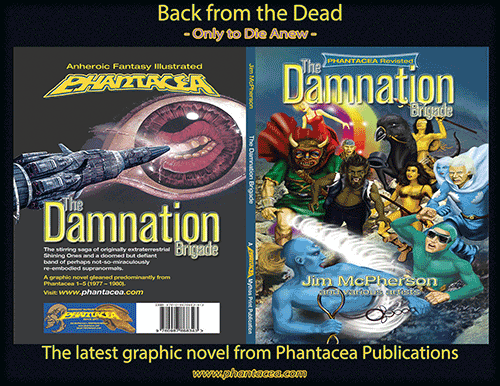
The Damnation Brigade
- Phantacea Revisited 1 -
Published in 2013; main webpage is here; ordering lynx are here
Cataclysm Catalyst
- Phantacea Revisited 2 -
Published in 2014, main webpage is here; ordering lynx are here
Kadmon Heliopolis had one life. It ended in October 1968. The Male Entity has had many lives. In his fifth, he and his female counterpart, often known as Miracle Memory, engendered more so than created the Moloch Sedon. They believe him to be the Devil Incarnate. They've been attempting to kill him ever since. Too bad it's invariably he, Heliosophos (Helios called Sophos the Wise), who gets killed instead.
On the then still Whole Earth circa the Year 4000 BCE, one of their descendants, Xuthros Hor, the tenth patriarch of Golden Age Humanity, puts into action a thought-foolproof, albeit mass murderous, plan to succeed where the Dual Entities have always failed. He unleashes the Genesea. The Devil takes a bath.
Fifty-nine hundred and eighty years later, New Century Enterprises launches the Cosmic Express from Centauri Island. It never reaches Outer Space; not all of it anyhow. As a stunning consequence of its apparent destruction, ten extraordinary supranormals are reunited, bodies, souls and minds, after a quarter century in what they've come to consider Limbo. They name themselves the Damnation Brigade. And so it appears they are -- if perhaps not so much damned as doomed.
At least one person survives the launching of the Cosmic Express. He literally falls out of the sky -- on the Hidden Continent of Sedon's Head. An old lady saves him. Except this old lady lives in a golden pagoda, rides vultures and has a third eye. She also doesn't stay old long. He becomes her willing soldier, acquires the three Sacred Objects and goes on a rampage, against his own people, those that live.
Meanwhile, Centauri Island, the launch site of the Cosmic Express, comes under attack from Hell's Horsemen. Only it's not horses they ride. It's Atomic Firedrakes!
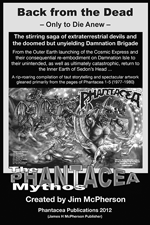
Phantacea Revisited graphic novels morph into full length Phantacea Mythos mosaic novels; only the beginnings, middles and endings have changed to protect what really happened
Cataclysm Catalyst
The second Phantacea Revisited Graphic Novel
Full cover by Verne Andru, 1980-2013
- Double-click to enlarge -
Internal Artwork Credits
Artwork from pH 1-7 as well as Phantacea Phase One #1; samples link from here;
Ian Bateson's unpublished artwork from Phantacea Seven provides the basis for the first full-length phantaceaMythos Mosaic Novel since "Goddess Gambit".
Check out the expanded Availability Listings for places you can order or buy Phantacea Publications in person
Look out Below!
Nuclear Dragons are here
- A phantaceaMythos Mosaic Novel -
The second entry in the 'Launch 1980' story cycle is now available for ordering online
Double-click on images to enlarge in a separate window
Dedicated webpage is here; back cover text can be found here and here; lynx to excerpts from the book start here and here; check out material that didn't make it here and related excerpts from its scheduled follow-up, 2014's "Helios on the Moon", here; its Auctorial Preamble is reprinted here, here and here
Centauri Island
- Web-Serial to Novel -
At long last, the second entry in the Launch 1980 epic fantasy has arrived.
Ian Bateson's breathtaking wraparound cover for the novel utilizes his own dragons from pH-7. Those from the unfinished cover for the Phantacea Phase One project can be seen here and here.
Double-click on rollover to open a separate window featuring the full cover of "Goddess Gambit"; red sampler enlarges here
Phantacea Publications is pleased to announce "Goddess Gambit", the third and final book in 'The Thrice-Cursed Godly Glories' epic trilogy, is available for ordering both online and directly from the publisher
(Please note: Phantacea Publications can only accept cheques and money orders.)
Phantacea Publications is pleased to announce the three mini-novels constituting "The 1000 Days of Disbelief", Book Two of 'The Thrice-Cursed Godly Glories', are available for ordering online by credit card.
"Feeling Theocidal -- Thrygragon, Year of the Dome 4376" (Book One of 'The Thrice-Cursed Godly Glories' trilogy), "The War of the Apocalyptics" (the first full-length entry in the Launch 1980 story cycle), the three mini-novels making up "The 1000 Days of Disbelief" (Book Two of 'The Thrice-Cursed Godly Glories'), "Goddess Gambit" (Book Three of the trilogy and in some respects the second – unless it's the third – entry in the Launch 1980 story sequence) and "Nuclear Dragons" (the second, full-length entry in the Launch 1980 story sequence) should be available at neighbourhood bookstores and public libraries all over the world.
"Janna Fangfingers", the third and final mini-novel comprising 1000-Daze, rather cleverly doubles as a prequel to both Gambit and the Launch 1980 story cycle. In its turn, Endgame-Gambit picks up from where War-Pox leaves off. Part Three of "Nuclear Dragons" connects to both War-Pox and Gambit. Parts One, Two and Four of Nuke also nicely sets up "Helios on the Moon", the last scheduled sequence in the Launch 1980 story cycle.
E-versions of Feel Theo, Hellion, Contagion,Fangers, War-Pox and Gambit are available on the Kindle format exclusively from amazon.com, amazon.co.uk and some of amazon's other European and Asian affiliates.
Kindle e-books can be downloaded for I-Pads and I-Phones as well as a number of other devices. Many have text-to-voice capacity for the visually challenged.
Phantacea Publications e-books are also available in a variety of other formats. Please check your favourite online bookstore to download Phantacea Publications e-books to the device of your choice.
Some of the Phantacea comics and graphic novels can be ordered through Drive Thru Comics.
Or, if you prefer to order directly from the publisher, email or send your order(s) via surface mail. No matter where you live or what currency you prefer to use, I'll figure out a way to fill your order(s) myself.
Please add an additional 12% to cover Canadian and provincial taxes as well as Canada Post rates for shipping. At present Phantacea Publications can only accept certified cheques or money orders.
Another interesting option for the curious is Chegg, which has a rent-a-book program. Thus far its search engine shows no results for phantacea (any style or permutation thereof) but it does recognize Jim McPherson (a variety of them) and the titles of the novels.
As for the Whole Earth (other than the Hidden Continent of Sedon's Head, at least as far as I can say), this page contains a list of a few other websites where you can probably order the novels in a variety of currencies and with credit cards.
WRAPAROUND
COVER: Creative Team listed on the front cover are Jim
McPherson (creator/writer/publisher) and Ian Fry (artist); overall pencils,
inks, colour and typesetting on the cover are by Ian Bateson, 1990;
(PUBLISHER’S NOTE: final rendition actually redrawn and coloured
by Ian Bateson, who also handled the typesetting, over a design by Jim
McPherson and original artwork by Ian Fry, 1989);
CHARACTERS
ON FRONT COVER: Xuthros Hor (the Biblical Noah as a samurai)
holding a spear in his left hand and the reins of Raven’s Head in
the other; thunder and lightning, torrential rainstorm, the beginning
of the Deluge;
ON BACK
COVER: depiction of a massive, octagonal boat intentionally
reminiscent of Noah’s Ark foundering in tempestuous seas; text on
back written by Jim McPherson;
BACKGROUND
NOTES:
- Jim McPherson’s first work to appear in PHANTACEA
came in PHANTACEA #1, 1977; Ian Fry’s
first work to appear in PHANTACEA came in PHANTACEA
Phase One #1, 1987; Ian Bateson’s first work to appear in PHANTACEA
came in PHANTACEA #2, 1978; the
nine sequences making up the graphic novel were initially prepared as
backup features to the projected, 15-issue series entitled PHANTACEA
Phase One;
- Raven’s Head is a huge horse with talarial wings on both sides
of her hooves, a unicorn horn and a raven’s head; Blind Sundown
(not a samurai, a North American Human Being or, more commonly, a Cheyenne),
his Solar Spear and Raven’s Head herself first appeared in PHANTACEA
#2, 1978; the Great Flood of Genesis is referred to as the Genesea throughout
the PHANTACEA Mythos;
SUMMARY OF CONTENTS:
The graphic novel, entitled “Forever & 40 Days”, occupies
pages 4-71. Written by Jim McPherson, illustrated by Ian Fry and lettered
by the team of Linsea Stamer, Ian Fry and Fred Armstrong, it breaks down
to nine sequences. These follow the time-tumbler, Helios called Sophos
the Wise, and his most aberrant generation, the Moloch Sedon, through
a series of evidently random encounters ending, circa 4000 BC, with the
Genesea and the preservation of what henceforth becomes the Hidden Continent
of Sedon's Head.
A short story, entitled “Sister Grandmother”, occupies pages
74-83. Written by Jim McPherson, it features concepts, 6 illustrations
and some characters (notably Wilderwitch and Wildman Dervish Furie) from
the PHANTACEA Mythos as originally presented
in the 6-issue PHANTACEA comic book series from
1977-1980.
The balance of the material is a 1-page frontispiece, a 2-page introduction
written by Jim McPherson, a 2-page set of details and charts compiled
and written by Jim McPherson re the 10 Golden Age Patriarchs of Humankind,
and a 1-page PHANTACEA Price List including
black-and-white reproductions of all seven previous covers in the franchise.
"Helios as history," thinks
Ryne, "What a horrid concept!" Yet history is exactly what Kadmon
Heliopolis, orphaned son of Second World War Greek Freedom Fighters, becomes.
When the Devil came into existence,
Helios acted. When the Devil was driven out of Weirsystem, Helios pursued.
When the Devil fled through the heavens, Helios attacked. When the Devil
came to Earth, Helios followed. But the Entity called Sophos the Wise
could never rid the Cosmos of the Evil he helped create. That task fell
to Xuthros Hor, the Tenth Patriarch of Golden Age Humankind.
High atop Mt. Ararat, Hor summoned
the Deluge. Sedon, the Eternal Antagonist called for a bar of soap.
"Taking Genesis literally troubled
me. Taking Genesis as Mythology --- like The Iliad or The Eddas --- was
inspirational."
PAGE
1: Frontispiece listing credits for the overall package;
the credits are Jim McPherson (creator/writer/publisher); Ian Fry (artist);
the three letterers who worked on the graphic novel (henceforth referred
to as the lettering team): Linsea Stamer, Ian Fry and Fred Armstrong;
Cover Illustration by Ian Bateson; Production by Baseline Type and Graphics;
Printing by Ark Service Printers (Printed on Recycled Paper); and a logo
reading: ‘Anheroic Fantasy Illustrated – PHANTACEA
– Since 1977’;
PAGES
2-3: Introduction written by Jim McPherson, November
1989; illustration entitled “Cain, Slayer of Abel” by Ian
Fry, 1988; usual declaimers at bottom of pg 2 (1st printing May 1990;
published by Jim McPherson; etc)
Professor Romaine Kinesis and Cosmicaptain Mikelangelo
Starrus are among those depicted by Dave Sim on back cover of pH-1,
published in the Fall of 1977;
PAGES
4-14: Sequence One entitled “Pre-Forever”;
written by Jim McPherson, illustrated by Ian Fry and the lettering team
(Linsea Stamer, Ian Fry and Fred Armstrong);
Characters featured include: Jordan Tethys (aka the Legendarian), Melina
nee Sarpedon Zeross, her now late in-laws (Megaera nee Kinesis and Angelo
Zeross, along with their eldest son, Demonites), Loxus Abraham Ryne, O’Ryan
James Maxwell, James Aremar, Mikelangelo Starrus and the Gypsium Triumvirate
(Kadmon Heliopolis, Professor Romaine Kinesis and Dr Aristotle Zeross,
who were central characters in the PHANTACEA
comic book series);
Significant events depicted: deaths of elder Zerosses; Aegean
Trigon (a tri-peaked islet near Santorini) being struck by bomb dropped
by AMERICA pilot Starrus and thereafter disappearing into the time-stream,
presumably taking Heliopolis with it);
Additional notes: 1st appearances of OJ Maxwell
(later the ‘Indescribable Mr No Name’), Mik Starrus
(later the ‘Primordial Powerhouse’) and Rom Kinesis
(later ‘Doc Defiance, the Gypsium Man’) came in PHANTACEA
#1, 1977; 1st appearances of Abe Ryne (the then current patriarch of the
multi-millennia extant ‘Illuminated Faith of Xuthros Hor’),
James Aremar (commander of the UNES Liberty), Kadmon Heliopolis (‘Heliosophos’)
and Harry Zeross (‘Ringleader’) came in PHANTACEA
#3, 1978; an abbreviated version of events in this sequence were related
in PHANTACEA #3;
An
image suggestive of 'the Great Man', Abe Ryne, circa 1980
PHANTACEA Notes:
Virtually all the characters who appear in this sequence of '4-Ever & 40-Days' have been major characters in one, another or a number of the Web Wheaties, as in serials, thus far presented during the course of pH-Webworld;
PAGES
15-22: Sequence Two entitled “Tail Teller”;
written by Jim McPherson, illustrated by Ian Fry and the lettering team
(Linsea Stamer, Ian Fry and Fred Armstrong);
Characters featured include: kids capturing a rat-like tee-tee (they pull
its tail, it vocalizing the tale), Helios called Sophos the Wise (presumably
an incarnation of Kadmon Heliopolis from Sequence
One), the Mnemosyne Machine, a Utopian scientocrat by the name of
Cabalarkon and the Moloch Sedon (arguably none other than the Devil himself);
there’s a brief cameo by Vayu Maelstrom (Devil Wind) as well;
Significant events depicted: generation of the Moloch Sedon by Helios,
Mnemosyne and Cabalarkon; Helios’s 5th death; Trans-Time Trigon
tumbles randomly back into the time-stream carrying the Mnemosyne Machine
with it;
Additional notes: Vayu Maelstrom (Devil Wind) first appeared in PHANTACEA
#1, 1977, where he was among those depicted on its back
cover; Utopians
(men always black; women always white) first appeared in PHANTACEA
#2, 1978; theMnemosyneMachine
and theMolochSedon first appeared in PHANTACEA
#3, 1978;
The Trigon Asteroid came out of the time stream at
the beginning of the Male Entity's 5th Lifetime. It thereupon became
part of the First Weirsystem. Some time later, under the watchful eyes
of the Mnemosyne Machine, the Moloch Sedon emerged fully formed from
a tub of Cathonic Fluid.
Also depicted in this somewhat digitally dicked,
Ian Fry illustrated sequence are Heliosophos and now 1-eyed Cabalarkon,
the ultimately Undying Utopian Sedon regards as his true father.
PAGES
23-29: Sequence Three entitled “Sedon –
Master of Weir”; written by Jim McPherson, illustrated by Ian Fry
and the lettering team (Linsea Stamer, Ian Fry and Fred Armstrong);
Characters featured include: the Moloch Sedon, Helios, Cabalarkon and
the Trigregos Sisters (Demeter, Devaura & Sapiendev); other 3-eyed
devils, including the Thrygragos Brothers (Varuna Mithras, Lazareme the
Libertine & Great Byron), are shown but not named;
Significant events depicted: Helios, in an unspecified lifetime, has the
Mnemosyne Machine nuke Weir Star (Supernova 1987A, its explosion, as seen
on our Earth multi-multiple millennia later, frames this sequence) in
order to wipe out devakind (save the 3 Sisters, who can humanize Mnemosyne,
rendering her Milady Memory, the Female Entity to Helios’s Male
Entity);
Additional notes: the Six Great Gods (the Trigregos Sisters and the Thrygragos
Brothers) first appeared in PHANTACEA #4, 1978;
Lazareme the Libertine also looks like Helios;
PAGES
30-37: Sequence Four entitled “Tell Tail”;
written by Jim McPherson, illustrated by Ian Fry and the lettering team
(Linsea Stamer, Ian Fry and Fred Armstrong);
Characters featured include: Jordan Tethys, aka the Legendarian (who tells
the tale by reading a tee-tee tail), the Moloch Sedon, Helios (as King
Kad, ruler of Trigon, a kingdom on New Weirworld), Cabalarkon, the Mnemosyne
Machine (now humanized by the Trigregos Sisters), and the Thrygragos Brothers;
Significant events depicted: Helios, in the same unspecified lifetime
as the previous sequence, is now a very, very old man; Cabalarkon, who
doesn't age anywhere near as fast, refines Cathonic Fluid in order
to rejuvenate him; unfortunately, it works so well Helios ages all the
way back to protoplasm and dies;
Abandoning the traitorous Trigregos Sisters on New Weirworld, but taking
thought-father Cabalarkon with him, the Moloch Sedon forms the Sedonshem
and rockets away with his three, now sterilized sons and their thousands
of surviving, but always insubstantial offspring by the Trigregos Sisters;
Although Machine-Machine succeeded
in destroying Weirstar, its explosion did not result in the complete destruction
of devakind.
Led by their Grandfather Sedon and
his three second generational sons, the Thrygragos Brothers, they reach
New Weirworld, where Helios now lives as King Kad and Memory is being
humanized by the Trigregos Sisters.
Kyprian Somata, the Master of Weir
in 5938 YD, recounted much the same story as that contained in Sequence
Four during the course of 'Helioddity',
She called it "Helios
Goes Nuclear".
PAGES
38-46: Sequence Five entitled “Sedon Brings
Hell To Earth”; written by Jim McPherson, illustrated by Ian Fry
and the lettering team (Linsea Stamer, Ian Fry and Fred Armstrong);
Characters featured include: the Moloch Sedon, the Thrygragos Brothers,
Anti-Patriarch Cain (who looks a lot like old King Kad from the previous
sequence), some of the Golden Age Patriarchs of Humankind (one of whom
is Pseth Ra, the Biblical Seth, 3rd son of Adam & Eve) and a number
of 3-eyed Master Devas, most especially Multi-Horns
(Cruel Plathon), the Bull of Mithras;
Significant events depicted: the Sedonshem lands atop Kanin City (on
an island in Lemuria, part of Eden's Zoo in the archipelago of Pacifica),
killing Droch Nor, the seventh patriarch of Golden Age Humanity (the
Biblical Enoch);
Anti-Patriarch Cain (yes, that Cain, the Biblical Slayer of Abel) is
duped by Multi-Horns
into having constructed a golden calf with an atomic heart; this, in
his 985th year of life, Cain ignites at the Gates of Eden, thereby killing
himself and a vast multitude of his followers (the suggestion is that
Cain is actually Heliosophos in his 1st lifetime);
Script on 'Sedon Brings ... Hell to Earth' image
reads: "In the Year since Zero, the Sedonshem
landed atop Kanin City in the Archipelago of Pacifica. Among the multitude
crushed to death beneath it was Droch Nor, the 7th Patriarch of Golden
Age Humankind!"
PAGES
47-57: Sequence Six entitled “The Day Before
Forever”; written by Jim McPherson, illustrated by Ian Fry and the
lettering team (Linsea Stamer, Ian Fry and Fred Armstrong);
Characters featured include: the Moloch Sedon, the Thrygragos Brothers,
various Golden Age Patriarchs of Humankind (#6, Jaro Dan, the Biblical
Jared, is patterned on the Aesgardian Odin) and a number of 3-eyed Master
Devas, one of whom, Biblio Drek (aka the Librarian or ‘Specks’
because his spectacles have 3-lenses), narrates the balance of the graphic
novel;
Significant events depicted: deaths of former patriarchs 2 thru 6; #5
(Mahurus Zir, the Biblical Mahalel) captures a Byronic Master Deva (Crinsom);
led by their father, Great Byron, the Byronics seek to free her;
Additional material: how the first Raven’s Head comes into being;
how #10 (Xuthros Hor) acquires his spear (the likes of which Blind Sundown
will possess more than 6000 years later); how Great Byron becomes Bodiless
Byron thanks to Hor, Raven and the spear; plus a brief, less than 1-page-long
summary of the PHANTACEA Mythos version of Ragnarok;
Xuthros Hor is shouting: "Let the skies
burst forth! Let the matchless fury of the ocean waves rise up! Flood
over this cursed planet! Wash the Earth clean of devas and all that
is evil!"
The text beneath the image reads: "The rain
came down in mighty torrents, and the subterranean waters burst forth
upon the earth for forty days and nights, and the water covered the
earth for 150 days."
PAGES
58-71: Sequence Seven entitled “Forever and
a Day”; written by Jim McPherson, illustrated by Ian Fry and the
lettering team (Linsea Stamer, Ian Fry and Fred Armstrong);
Characters featured include: the Moloch Sedon, the Thrygragos Brothers,
the last three Golden Age Patriarchs of Humankind (Amemp Tut, Oriartes
Ma & Xuthros Hor), Helios (as young fit-looking as Heliopolis appeared
in Sequence One), Cabalarkon (called the ‘Undying Utopian’
due to the fact he’s still alive, albeit confined to a tub of Cathonic
Fluid), and the Mnemosyne Machine (now humanized by a devil who looks
a lot like Nergal Vetala, the future Vampire Queen of the Dead);
Significant events depicted: Xuthros Hor (Patriarch #10) threatens to
destroy humanity if they don’t drive the Moloch Sedon and his devils
off the face of the earth; Sedon corrupts Amemp Tut (Patriarch #8, Hor’s
grandfather, the Biblical Methuselah, who dies in the same year as the
Genesea);
Heliosophos, the Mnemosyne Machine and Trans-Time Trigon tumble back into
the linear timeline of devils and Golden Age patriarchs; Oriartes Ma (Patriarch
#9, the Biblical Lamech, Hor’s father) kills Helios; Tut kills Ma
(his son); Hor kills Tut then operatically calls down, as well as up,
the Genesea and drowns almost everyone left;
The Moloch Sedon raises the Cathonic Dome out of his own essence, uses
it to cover the archipelago of Pacifica, fills in the gaps between islands
like Lemuria and thus brings into existence the Hidden Continent of Sedon's
Head; end graphic novel;
Additional notes: Nergal Vetala, the future Vampire Queen of the Dead,
first appeared in PHANTACEA #2, 1978;
PAGES
72-73: 2-page set of details re the Biblical Patriarchs
from Adam to Noah, including a chart as to when they were born (starting
with Adam’s birth at Year Zero and ending 1656 years later with
the Great Flood, when Noah was 600 years old), how long they lived and
when they died; this data was then applied to thePHANTACEA
Mythos timeline as Years Pre-Dome or PD (counting backwards from
Hor’s 600th year).
Notes also include information as to how their
PHANTACEA Mythos names came about (amalgams
of actual names taken directly from the Bible, Egyptian mythology and
an ancient list of the first 10 Chaldean kings).
Beneath the 'Sedon Brings ... Hell to Earth'
image, above, reference is made to a Year Zero.
This refers to the year given in the Bible for the birth of Adam.
Alorus Ptah is the PHANTACEA Mythos
name for the1st patriarch of Golden Age Humankind. He would have been
born (or at least brought up) in Old Eden. In all likelihood he would
also have been responsible for the Golden Agers' rebellion and, possibly,
for its subsequent sinking.
Within the PHANTACEA Mythos
Alorus Ptah was the Male Entity whereas the Female Entity was Tristar
Thrae (the Biblical Eve). She was the birth mother of Abel and Seth, the
2nd patriarch of Golden Age Humankind. PrimevalLilith, the
Queen of Demons, was the birth mother of Anti-Patriarch Cain.
PAGES
74-83: 10-page short story entitled “Sister Grandmother”;
illustrations include 4-pages from PHANTACEA
#1, all of which were drawn and lettered by Dave Sim in 1977; 1-page
from PHANTACEA #4, as drawn and lettered
by Verne Andru (signed Andrusiek) in 1979; and 1-page from PHANTACEA
#5, as pencilled by Vince Marchesano, inked by Mar + Day (their credits)
and lettered by Bill Payne in 1980;
Featured characters include: Wilderwitch and Wildman Dervish Furie (from
the Damnation Brigade), three of the Death Dodgers, Loxus Abraham Ryne,
James Aremar and a number of newcomers to the series (Fey Woman, Hush
Mannering, Auguste Moirnoir and six of the Silver Signallers not seen
but referred to in PHANTACEA #1);
Story setting: mostly in Athens and Santorini (an Aegean Island near
where Trans-Time Trigon vanished in Sequence One
of the graphic novel); the year is 1986, 6 years after the comic book
series ended and, in terms of thePHANTACEA Mythos,
a few months after the nuclear catastrophe at the Soviet Supra City
in the Ukraine that supposedly resulted in the complete obliteration
of the Hidden Continent of Sedon's Head;
Story synopsis: Wilderwitch and Furie’s alter ego, Gentleman Dervish
Furie, were lovers; Fey Woman (Wilderwitch’s
daughter, born in 1947 by an unidentified father) and Furie are lovers;
Fey has Furie’s baby but he’s sickly;
Hush Mannering (Young Life) and Auguste Moirnoir (Young Death) hate
each other; they’re also faerie-dusted tricksters familiar to
Fey, Furie and Wilderwitch from the Hidden Continent of Sedon's Head;
they’re forever seven years old, have been since 1920 when they
were both 17 and married to each other; Auguste can preserve the baby’s
life but only by transferring Furie’s life force from Murray to
the baby;
Meanwhile, the Silver Signallers are charged with tracking down and
disposing of the remaining Death Dodgers, all of whom were or are clones
of thought-dead supranormals like Wilderwitch and Furie; one of them,
Windrush, is Wilderwitch’s clone; Fey Woman considers Windrush
her daughter because she helped both to clone her as well as to raise
her; things get even more complicated;
Additional notes: The Death Dodgers and Nick Stiletto, one of the then
ostensibly 17-strong Silver Signallers, first appeared in PHANTACEA
#1, 1977; the Damnation Brigade first appeared in PHANTACEA
#2, 1978;
There may be no cure for aphantasia (defined as 'having a blind or absent mind's eye') but there certainly is for aphantacea ('a'='without', like the 'an' in 'anheroic')
Interactive PDFs of some of the Phantacea Mythos books and graphic novels released by Phantacea Publications are available for downloading from One Book Shelf and its frontline ordering sites: Drive Through Fiction and Drive Through Comics




![[<em>>PHANTACEA</EM> Logo 2]](graphicimages/pHWeb/logo1.jpg)
![[Cover of 'pH4-Ever & 40']](graphicimages/pH4Ever/bookcov1.jpg)


![[<em>PHANTACEA ONE</em> Back Cover]](graphicimages/pH1/fecilita.jpg)
![[ABE RYNE LOOKS SOMETHING LIKE THIS, SHOT OF A STATUE IN VIENNA, 1996]](graphicimages/Characters/ryne12.jpg)
![[MR. NONAME BATTLING DOLPH DULLES, FROM PH-2]](graphicimages/pH2/nonam13.jpg)